GHK-Cu side effects: what the research reports
In the published topical trials, GHK-Cu was well tolerated, with occasional mild skin irritation and no systemic adverse events reported. Copper toxicity is the theoretical concern at high exposure, but the copper in GHK-Cu is tightly bound and delivered in microgram quantities. There is no human safety data for injectable GHK-Cu; that use is unstudied, not proven safe.
Topical safety record
GHK-Cu has been used in cosmetics for decades and appears in the CIR (Cosmetic Ingredient Review) literature as safe at the concentrations used. The 12-week controlled facial studies reported no serious adverse events; a small proportion of subjects noted transient redness or itching. Cosmetic use in Australia is permitted.
Copper
The human body handles copper through ceruloplasmin and hepatic excretion, and GHK binds copper strongly enough that free copper exposure from the peptide is very low. A 50mg vial of GHK-Cu contains roughly 8mg of copper in total, bound in the complex. Copper toxicity in humans is associated with gram-scale ingestion or Wilson's disease, not with peptide-bound microgram exposure.
Injectable use: no human data
The safety record above is topical. No controlled human trial of injectable GHK-Cu has been published, so there are no data on systemic adverse events, injection-site reactions or long-term effects. Absence of data is not evidence of safety. Peptide Aus supplies GHK-Cu for in-vitro research and provides no guidance for use in people.
Interactions and cautions in the literature
In-vitro work suggests GHK-Cu can influence gene expression broadly, including genes involved in cell growth. Researchers working with proliferative cell lines should account for that. There are no established drug interactions because no human systemic use has been studied.
Frequently asked questions
Is GHK-Cu safe?
Topically, at cosmetic concentrations, the published record is good. For any other route the safety data do not exist.
Can GHK-Cu cause hair loss?
The research points the other way: increased follicle size and prolonged growth phase in models. No study has reported hair loss as an effect.
Does GHK-Cu cause cancer?
In cell studies GHK-Cu downregulated several genes associated with cancer progression. No study has linked it to causing cancer. Neither finding is a clinical conclusion.
Kits
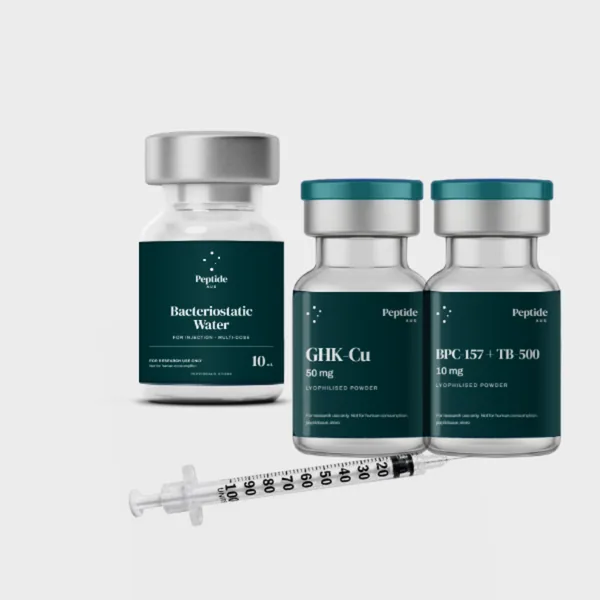
Build-Your-Own GLOW
GHK-Cu 50mg plus the BPC-157 + TB-500 blend, with water, forty syringes and swabs: GLOW's components as separate vials.

GHK-Cu Skin Pack (2 x 100mg)
Two GHK-Cu 100mg vials with water, sixty syringes and swabs, for longer skin and cellular protocols.
Related products