Metabolic Trio
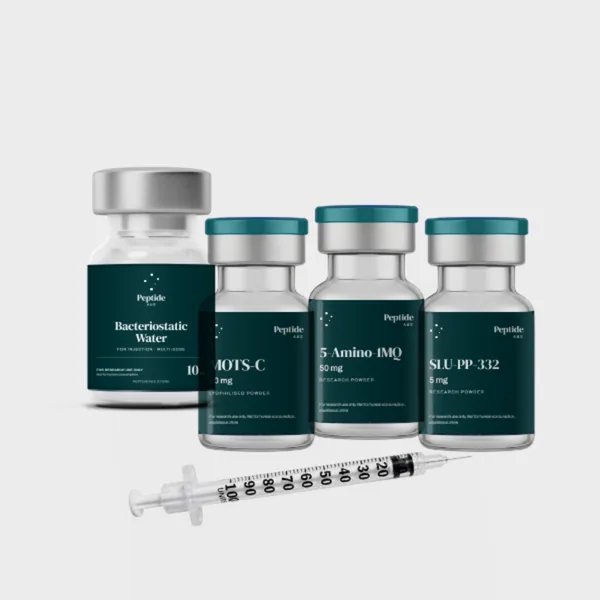
MOTS-c, 5-Amino-1MQ and SLU-PP-332 with water, forty syringes and swabs: the three metabolic research tools people compare.
$341.99

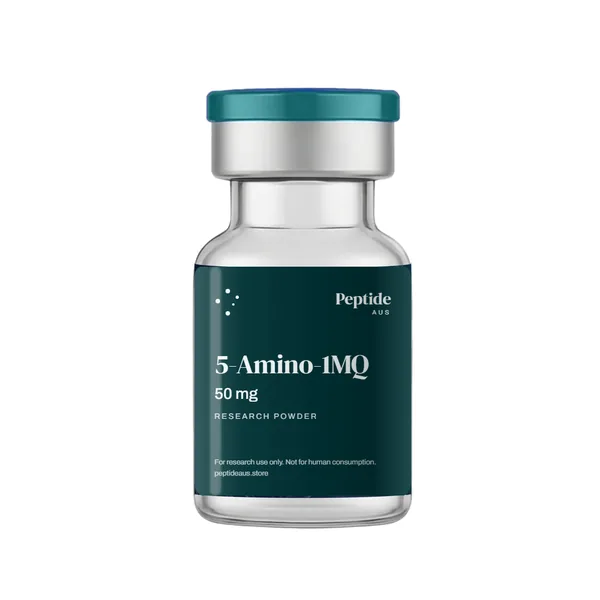
Research 5-Amino-1MQ vial, dispatched from Australian stock. In Stock
5-Amino-1MQ is not a peptide. It is a small quinolinium molecule that inhibits nicotinamide N-methyltransferase (NNMT), an enzyme that consumes nicotinamide and S-adenosylmethionine. Because it is supplied as a powder for reconstitution and studied alongside metabolic peptides, it sits in the same catalogue.
NNMT activity rises in white adipose tissue in obesity and diverts nicotinamide away from NAD+ synthesis. Blocking the enzyme leaves more nicotinamide for the NAD+ salvage pathway and raises SAM availability, which in preclinical work shifts adipocyte metabolism toward oxidation.
Rodent studies (Neelakantan et al., Biochem Pharmacol 2018) reported reduced adipocyte size, lower body-fat mass and improved metabolic markers in diet-induced obese mice without a change in food intake. Later work examined muscle stem-cell function and NAD+ levels in aged tissue.
Also known as: 5-amino-1-methylquinolinium, 5-A-1MQ
Certificate of analysis. Every batch carries a certificate from an independent laboratory. Request the certificate for your batch with your order number and we send it.
For in-vitro research and laboratory use only. Not for human or veterinary use. By purchasing you confirm you are a qualified researcher and will use this compound in accordance with all applicable laws.
Small-molecule NNMT inhibitor. 5-Amino-1MQ is not a peptide. It is a small quinolinium molecule that inhibits nicotinamide N-methyltransferase (NNMT), an enzyme that consumes nicotinamide and S-adenosylmethionine. Because it is supplied as a powder for reconstitution and studied alongside metabolic peptides, it sits in the same catalogue.
NNMT inhibition: enzyme kinetics and selectivity. Adipose metabolism: adipocyte size and fat mass in obese rodents. NAD+ salvage pathway: nicotinamide sparing and cellular NAD+. Muscle regeneration: stem-cell activation in aged muscle models. Rodent studies (Neelakantan et al., Biochem Pharmacol 2018) reported reduced adipocyte size, lower body-fat mass and improved metabolic markers in diet-induced obese mice without a change in food intake. Later work examined muscle stem-cell function and NAD+ levels in aged tissue.
Diet-induced obese mice showed reduced adipocyte size, lower body-fat mass and improved metabolic markers over several weeks without a change in food intake; there are no controlled human trials.
No human safety data exist. Rodent studies did not report toxicity at the doses used; NNMT inhibition affects methylation balance, which is a theoretical concern for longer exposure.
Published 5-Amino-1MQ studies specify their own amounts and routes, and those vary by model and endpoint. Peptide Aus products are supplied for in-vitro laboratory research, so we do not provide dosing, cycle or usage guidance for people. For laboratory preparation, the reconstitution calculator converts vial size and water volume into concentration and syringe units.
5-Amino-1MQ is orally bioavailable in rodent studies, and it is supplied here as a powder for reconstitution, the same handling as the peptides it is studied alongside. Peptide Aus does not provide usage guidance for people.
MOTS-c is a mitochondrial peptide that activates AMPK; 5-Amino-1MQ is a small molecule that inhibits NNMT. Both are studied for metabolic flexibility through different routes.
SLU-PP-332 activates ERR receptors to mimic exercise signalling; 5-Amino-1MQ blocks an enzyme that consumes NAD+ precursors.
AOD-9604 acts directly on adipocyte lipolysis; 5-Amino-1MQ acts on adipocyte metabolism through NNMT.
Add about 2 mL of bacteriostatic water slowly down the inside of the vial and swirl gently; do not shake. 50mg in 2 mL gives 25 mg/mL. Refrigerate at 2–8 °C after reconstitution and use within 8–12 weeks. The calculator has this vial preset.
Lyophilised: −20 °C, sealed, away from light and moisture. Reconstituted: 2–8 °C, used within 8–12 weeks, never frozen.
5-Amino-1MQ is not registered by the Therapeutic Goods Administration (TGA) as a medicine in Australia and is not approved for human or veterinary use. Peptide Aus supplies it as a research reagent for in-vitro laboratory work only. Supply of any substance for human use in Australia is governed by the Poisons Standard and the Therapeutic Goods Act, and the buyer is responsible for using the material lawfully. If you are looking for a treatment, speak to a doctor.
Directly from Peptide Aus, from Australian stock: 5-Amino-1MQ (50mg) is $109.99 AUD including GST. Paid orders before 2pm AEST/AEDT dispatch the same business day, tracked.
MOTS-c, 5-Amino-1MQ and SLU-PP-332 with water, forty syringes and swabs: the three metabolic research tools people compare.