
GHK-Cu in Australia
GHK-Cu is available in Australia as a research-grade lyophilised vial for laboratory use, in 2 sizes from $99.99 (50mg) to $149.99 (100mg), shipped from Peptide Aus stock. It is not approved for human use.
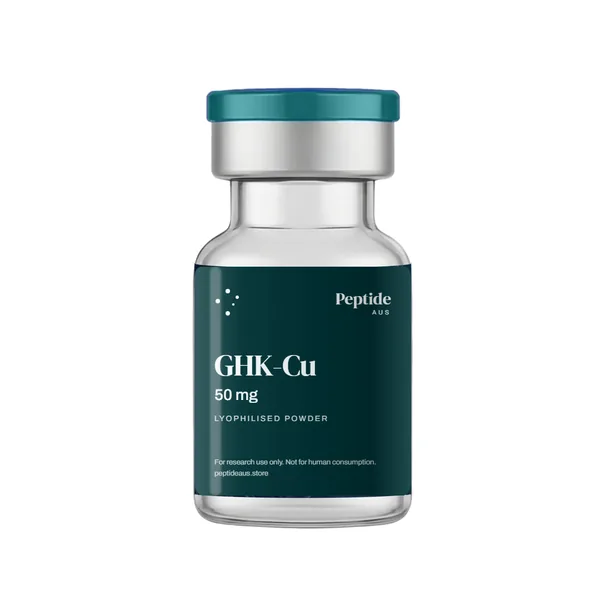
Vial sizes and prices
| Product | Price | Per mg | Stock |
|---|---|---|---|
| GHK-Cu (50mg) | $99.99 | $2.00/mg | In Stock |
| GHK-Cu (100mg) | $149.99 | $1.50/mg | In Stock |
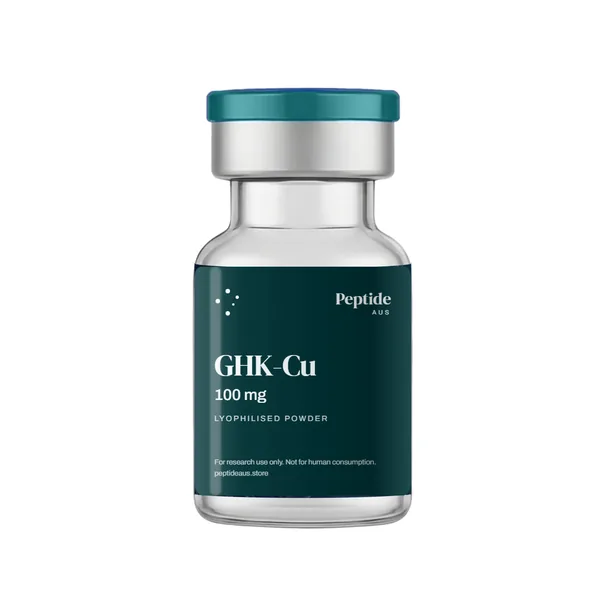
What GHK-Cu is
Copper-binding tripeptide (glycyl-L-histidyl-L-lysine:Cu²⁺)
GHK-Cu is a naturally occurring tripeptide that binds copper with high affinity. It was first isolated from human plasma in 1973, where its concentration falls from roughly 200 ng/mL in young adults to about 80 ng/mL by age 60. Research interest spans wound repair, collagen synthesis, hair follicle biology and gene-expression modulation in aged tissue. The same molecule appears at low concentration in cosmetic serums; the research vial is the pure copper complex.
How it works
GHK-Cu delivers copper to enzymes that need it, including lysyl oxidase, which cross-links collagen and elastin, and superoxide dismutase. Independently of copper delivery, the peptide binds to DNA-regulatory sites: a broad gene-expression study (Pickart et al., Oxid Med Cell Longev 2012) reported that it reset the expression of several thousand genes toward a younger profile in cultured cells, including genes involved in tissue remodelling and antioxidant defence.
What the research reports
Wound studies in animals and small human trials reported faster closure and increased collagen deposition. Controlled facial studies of topical GHK-Cu creams reported improved skin thickness, elasticity and fine-line depth over 12 weeks. Hair studies show increased follicle size in culture and animal models. Most data are topical or in-vitro; injectable research is limited to preclinical work.
Key research areas
- Collagen and elastin synthesis — Fibroblast stimulation and lysyl oxidase activity
- Wound healing — Closure rate and remodelling in animal and human wounds
- Gene expression — Broad transcriptional effects in aged and cancer cell lines
- Hair follicle biology — Follicle size and growth-phase markers
- Antioxidant defence — SOD activation and iron release inhibition
Also known as: Copper peptide, GHK copper, GHKCu, Copper tripeptide-1, ghku, chk cu, ghcku, copper tripeptide-1
Is GHK-Cu legal in Australia?
GHK-Cu is permitted in cosmetics at topical concentrations, but no injectable or research-grade GHK-Cu product is approved for human use in Australia. Peptide Aus supplies the vial for in-vitro laboratory research only.
Frequently asked questions
What is GHK-Cu?
Copper-binding tripeptide (glycyl-L-histidyl-L-lysine:Cu²⁺). GHK-Cu is a naturally occurring tripeptide that binds copper with high affinity. It was first isolated from human plasma in 1973, where its concentration falls from roughly 200 ng/mL in young adults to about 80 ng/mL by age 60. Research interest spans wound repair, collagen synthesis, hair follicle biology and gene-expression modulation in aged tissue. The same molecule appears at low concentration in cosmetic serums; the research vial is the pure copper complex.
What is GHK-Cu studied for?
Collagen and elastin synthesis: fibroblast stimulation and lysyl oxidase activity. Wound healing: closure rate and remodelling in animal and human wounds. Gene expression: broad transcriptional effects in aged and cancer cell lines. Hair follicle biology: follicle size and growth-phase markers. Antioxidant defence: sOD activation and iron release inhibition. Wound studies in animals and small human trials reported faster closure and increased collagen deposition. Controlled facial studies of topical GHK-Cu creams reported improved skin thickness, elasticity and fine-line depth over 12 weeks. Hair studies show increased follicle size in culture and animal models. Most data are topical or in-vitro; injectable research is limited to preclinical work.
GHK-Cu before and after: what do the studies show?
Twelve-week controlled facial studies reported increased skin thickness and density on ultrasound, improved elasticity and reduced wrinkle depth on profilometry; wound studies reported faster closure; follicle cultures showed increased follicle size. The human data are topical.
What side effects has GHK-Cu research reported?
Topical GHK-Cu is well tolerated in the published trials, with occasional mild irritation. There are no human safety data for injectable use; copper exposure from the peptide is microgram-scale and bound.
What is the GHK-Cu dosage?
Published GHK-Cu studies specify their own amounts and routes, and those vary by model and endpoint. Peptide Aus products are supplied for in-vitro laboratory research, so we do not provide dosing, cycle or usage guidance for people. For laboratory preparation, the reconstitution calculator converts vial size and water volume into concentration and syringe units.
GHK-Cu serum, cream or the research vial?
Cosmetic serums and creams at 0.01–0.1% are the form the human skin studies used. The vial is the unformulated copper complex for laboratory work and formulation development.
GHK-Cu vs copper peptides: what is the difference?
'Copper peptides' in skincare usually means GHK-Cu, sometimes AHK-Cu; GHK-Cu is the one with the research record.
GHK-Cu vs AHK-Cu: what is the difference?
AHK-Cu is a different copper tripeptide studied mainly for hair; GHK-Cu has the broader skin and wound literature.
GHK-Cu vs GLOW: what is the difference?
GLOW is GHK-Cu blended with BPC-157 and TB-500 for combined skin and repair research.
Topical GHK-Cu serum or the research vial?
Cosmetic serums use GHK-Cu at low concentrations in a formulated base for skin application, and that is the form most of the human skin data used. The lyophilised vial is the unformulated copper complex with a batch certificate available on request, intended for laboratory study at concentrations a serum cannot deliver. Our topical-versus-injectable guide walks through the difference.
What does 'before and after' research on GHK-Cu actually measure?
Published studies measure skin thickness by ultrasound, elasticity by cutometer, wrinkle depth by profilometry, wound area, and follicle diameter in hair models. Our evidence guide summarises the endpoints and the size of the reported changes.
Is GHK-Cu legal in Australia?
As a cosmetic ingredient at topical concentrations, yes; it is used in registered cosmetics. Injectable or research-grade GHK-Cu is not approved for human use in Australia. Peptide Aus supplies the vial for in-vitro research only.
50mg or 100mg?
The 50mg vial suits shorter cell-culture or topical-formulation work. The 100mg vial roughly halves the cost per milligram for longer protocols.
How do you reconstitute GHK-Cu?
With bacteriostatic water added slowly down the inside wall of the vial, then swirled gently. Each vial size lists its suggested volume, and the calculator converts volume to concentration.
How should GHK-Cu be stored?
Lyophilised: −20 °C, sealed, away from light and moisture. Reconstituted: 2–8 °C, used within 8–12 weeks, never frozen.
Is GHK-Cu legal in Australia?
GHK-Cu is permitted in cosmetics at topical concentrations, but no injectable or research-grade GHK-Cu product is approved for human use in Australia. Peptide Aus supplies the vial for in-vitro laboratory research only.
Where can I buy GHK-Cu in Australia, and what does it cost?
Directly from Peptide Aus, from Australian stock, in 2 vial sizes from $99.99 (50mg) to $149.99 (100mg). Prices are AUD and GST inclusive. Paid orders before 2pm AEST/AEDT dispatch the same business day, tracked.
Kits with this compound
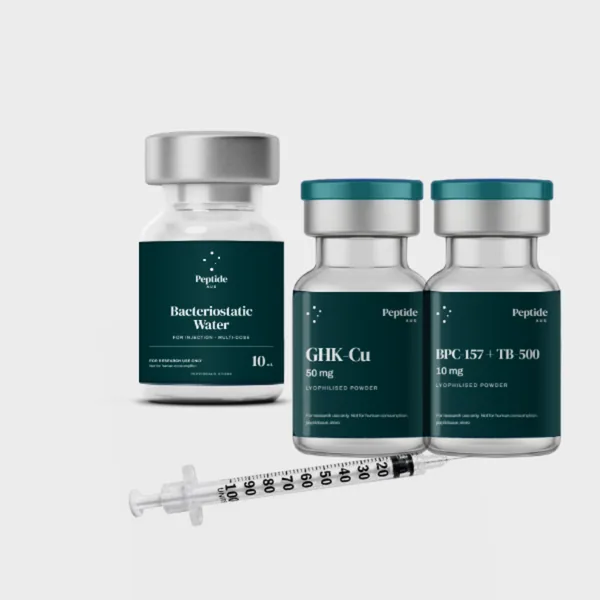
Build-Your-Own GLOW
GHK-Cu 50mg plus the BPC-157 + TB-500 blend, with water, forty syringes and swabs: GLOW's components as separate vials.

GHK-Cu Skin Pack (2 x 100mg)
Two GHK-Cu 100mg vials with water, sixty syringes and swabs, for longer skin and cellular protocols.
All GHK-Cu products are supplied for in-vitro research and laboratory use only. Not for human or veterinary use.